
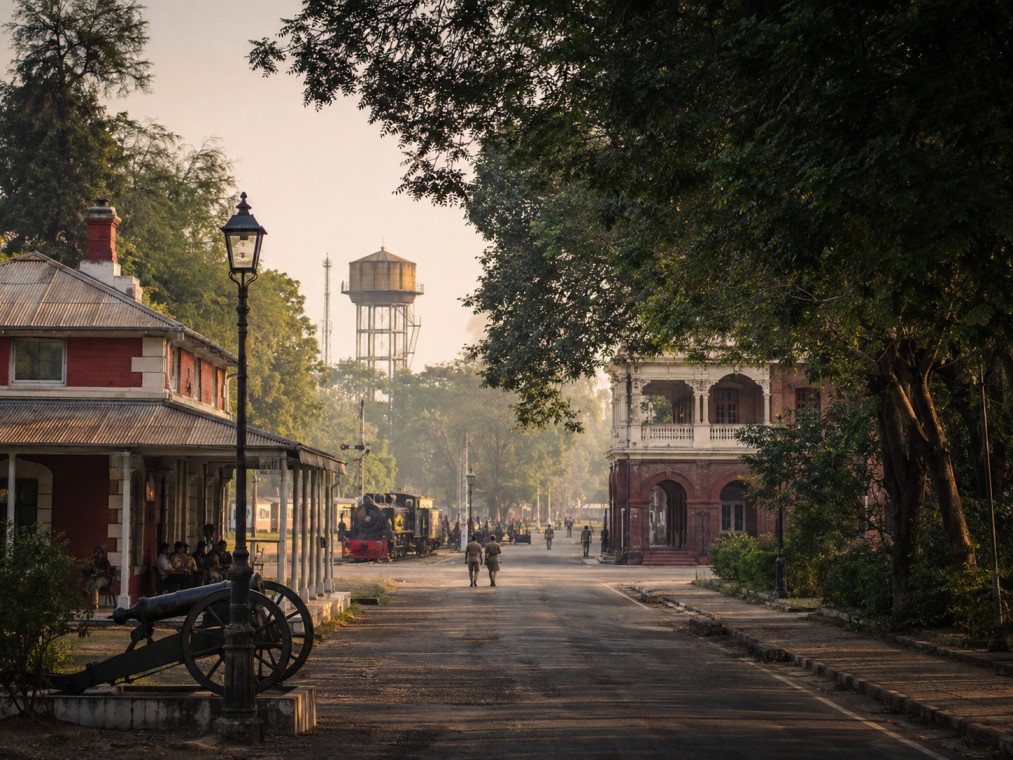

Ambala Cantonment, commonly known as Ambala Cantt, is one of the most historically important parts of Ambala, Haryana. Its identity is closely connected with the British period, military administration, the Revolt of 1857, railway connectivity and the development of Ambala as a major strategic centre in northern India.
For generations, Ambala Cantt has been more than a military establishment. It has developed into a distinctive urban area with markets, residential neighbourhoods, railway infrastructure, educational institutions, government offices and historic locations.
The story of Ambala Cantt is also an important part of the larger history of Ambala. The District Administration records Ambala’s political and military importance during British rule and specifically describes Ambala as a military depot of major importance during the Revolt of 1857.
If you are searching for Ambala Cantonment history, Ambala Cantt history, history of Ambala Cantt, Ambala military history, Ambala Cantt 1857 revolt, British history of Ambala or Ambala Cantt railway history, this guide explains how the cantonment became one of the most recognizable parts of the district.
Ambala Cantonment at a Glance
| Topic | Information |
|---|---|
| Location | Ambala district, Haryana |
| Common Name | Ambala Cantt |
| Historical Identity | Military and British-era centre |
| Major Historical Event | Revolt of 1857 |
| Railway Importance | Major railway connectivity through Ambala Cantt |
| Administrative Role | Sub-division of Ambala district |
| Modern Identity | Military, residential, commercial and transportation centre |
Ambala district currently lists Ambala Cantt as one of its four sub-divisions. The district also has six blocks, with Ambala Cantt included as one of them.
What Is Ambala Cantonment?
Ambala Cantonment is a distinct urban area associated historically with the military development of Ambala.
The word cantonment generally refers to a military station or area established for armed forces. During British rule in India, cantonments became important centres for the organisation, accommodation and administration of military units.
Ambala’s strategic location in northern India made it particularly suitable for military purposes.
Its location also connected it to major roads and, later, the railway network, further increasing its importance.
Why Was Ambala Important to the British?
The British considered the Ambala region strategically important because of its location in northern India.
The British administration expanded its influence in the region during the early 19th century. The official history of Ambala states that after the decline of Sikh power in the region, the British increased their influence beyond the Yamuna and brought local chiefs under their protection.
Ambala also became an important centre for dealing with political affairs in surrounding states.
The British established a Political Agency at Ambala, through which they exercised influence over states in the region. The political agency was later transformed into a commissionership.
This political role existed alongside Ambala’s military importance.
The Growth of Ambala Cantonment
The development of Ambala Cantonment needs to be understood within this broader British expansion.
As the British consolidated their position in northern India, military stations became increasingly important for troop movement, administration and regional security.
Ambala’s strategic location made it suitable for this purpose.
Over time, the cantonment developed its own infrastructure and identity, separate from the traditional commercial areas of Ambala City.
This difference between Ambala City and Ambala Cantt remains visible even today.
Ambala City vs Ambala Cantt
People sometimes use “Ambala” to refer to both Ambala City and Ambala Cantonment.
However, they have different historical identities.
Ambala City
Ambala City developed as a commercial and residential centre with markets, businesses and traditional urban neighbourhoods.
Ambala Cantonment
Ambala Cantt developed strongly around military and British administrative activity.
The two areas are geographically connected but have historically developed in different ways.
This distinction is important for anyone researching Ambala history, Ambala population, Ambala markets or Ambala tourism.
Ambala Cantonment and the Revolt of 1857
The most important chapter in Ambala Cantonment’s history is undoubtedly the Revolt of 1857.
The District Administration describes Ambala as a military depot of great importance during the uprising.
The cantonment was therefore directly connected to one of the most significant events in India’s 19th-century history.
What Happened in Ambala in 1857?
According to the official district history, a sepoy named Sham Singh, belonging to the 5th Native Infantry, warned Deputy Commissioner Forsyth near the end of April 1857 that a general sepoy uprising was expected in early May.
His warning proved accurate.
On 10 May 1857, the 60th Native Infantry reportedly rose in open revolt at Ambala at around 9 a.m.
The 5th Native Infantry followed at approximately noon.
British forces responded quickly and suppressed the uprising.
The events at Ambala are particularly important because they demonstrate that the military unrest of 1857 had reached major British military establishments in northern India.
Why Was Ambala Important During 1857?
Ambala’s importance during the Revolt of 1857 was connected to its role as a military depot.
Military units were stationed in the area, making the cantonment a potential centre of rebellion as well as a critical location for British military control.
The uprising in Ambala was suppressed, but the district continued to experience the social and political effects of the revolt.
The official district history states that the civilian population was also affected and that people from different communities participated in opposition to British rule.
Ambala Cantt After the Revolt of 1857
The British government responded to the 1857 uprising with major changes in military and administrative policy across India.
Ambala’s military importance continued after the revolt.
The cantonment remained part of the British military system and continued to develop as a strategic location.
The post-1857 period also witnessed increasing political awareness among people in Ambala.
Several social and religious organisations emerged during the late 19th century.
The official district history records Arya Samaj Ambala Cantonment in 1883, followed by organisations including Anjuman-Islamiya and Singh Sabha in Ambala Cantonment during the 1880s, and Sanatan Dharam Sabha in 1896.
This shows that Ambala Cantt was not only a military space; it was also becoming a centre of social and community activity.
Arya Samaj in Ambala Cantonment
The District Administration records the establishment of Arya Samaj Ambala Cantonment in 1883 with a focus on socio-religious reform.
The organisation formed part of the broader reform movements that developed in northern India during the late 19th century.
This period was important because social reform organisations increasingly became part of public life.
Singh Sabha in Ambala Cantonment
The official history also records the establishment of Singh Sabha in Ambala Cantonment in 1888, with the objective of reforming Sikh religious life.
The presence of different reform organisations illustrates the diverse social environment that developed around Ambala Cantt.
Sanatan Dharam Sabha
The district history records Sanatan Dharam Sabha Ambala Cantonment in 1896, associated with Hindu revivalism.
Together, these organisations form an important part of the social history of Ambala Cantonment.
Ambala Cantt and India’s Freedom Movement
Ambala Cantonment remained politically important during the early 20th century.
The district’s official history records growing political activity after the First World War.
People in Ambala opposed the Rowlatt Bills and participated in the wider national political movement.
The district also participated in Mahatma Gandhi’s Non-Cooperation Movement.
The 1/34 Sikh Pioneer Incident
One notable event occurred in Ambala Cantonment following the arrest of Mahatma Gandhi and the Jallianwala Bagh tragedy.
The official district history states that the office of the military regiment 1/34 Sikh Pioneer at Ambala Cantonment was burned during violent disturbances.
This incident demonstrates the extent to which national political developments affected local communities in Ambala.
Ambala Cantt During the Non-Cooperation Movement
The Non-Cooperation Movement mobilised people across India.
Ambala was also affected.
The district’s historical record says that people participated in Gandhi’s Non-Cooperation Movement before it was withdrawn in 1922 following the Chauri Chaura incident.
The movement helped strengthen political awareness in Ambala and connected local communities with India’s wider freedom struggle.
Ambala Cantonment and Railway Connectivity
Railway connectivity became another major part of Ambala Cantt’s identity.
Today, Ambala Cantt railway station is one of the best-known transportation landmarks associated with the area.
The District Administration maintains an official page for Railway Station Ambala Cantt, confirming the station as part of the district’s public infrastructure.
The railway helped strengthen Ambala’s position as a transportation centre.
For a cantonment with strategic military importance, railway connectivity was particularly valuable because railways provided an efficient method of moving people, supplies and military resources.
Why Ambala Cantt Railway Station Matters
Ambala Cantt railway station is important not only for local passengers but also because of Ambala’s broader position within northern India’s transportation network.
The railway connection contributed to:
- Passenger movement
- Trade
- Military logistics
- Employment
- Urban development
- Regional connectivity
The railway and cantonment therefore became interconnected elements in Ambala’s modern development.
Ambala Cantt and the Development of the City
The growth of the cantonment influenced the development of the surrounding urban area.
Military personnel, railway employees, traders, government workers, service providers and other communities contributed to the growth of residential and commercial neighbourhoods.
Over time, Ambala Cantt developed a distinctive urban character.
Today, the area includes:
- Residential colonies
- Markets
- Educational institutions
- Railway infrastructure
- Government offices
- Religious institutions
- Service businesses
- Military-related establishments
Markets of Ambala Cantonment
The commercial identity of Ambala Cantt developed alongside its military and transportation role.
Areas such as Sadar Bazaar, BC Bazaar, Rai Market and other local commercial zones are part of the area’s everyday identity.
The district’s current public records also list multiple banking and public-service locations in Ambala Cantt, demonstrating its continuing commercial and administrative role.
For AmbalaStory, each market can become a separate local SEO article.
For example:
- Sadar Bazaar Ambala Cantt Guide
- BC Bazaar Ambala Cantt
- Rai Market Ambala Cantt
- Best Shopping Areas in Ambala Cantt
- Famous Shops in Ambala Cantt
- Ambala Cantt Market Timings
These pages can then link back to the main Ambala Cantt guide.
Ambala Cantt and Education
The cantonment area has educational institutions serving local residents and surrounding communities.
Current district records contain references to schools and educational facilities in areas including Topkhana, BC Bazaar, Railway Colony and other parts of Ambala Cantt.
Education therefore forms another important part of the area’s modern identity.
Railway Colony and Ambala Cantt
Railway infrastructure also influenced the development of residential areas.
Current district records contain references to Railway Colony, North Railway Colony and railway-related institutions within Ambala Cantt.
This reflects the long-term connection between Ambala’s railway infrastructure and the city’s social geography.
Government Administration in Ambala Cantt
Ambala Cantt continues to have an important administrative role.
The current district administration lists Ambala Cantt as one of four sub-divisions of Ambala district.
The district’s current administrative directory also lists the office of the Sub-Divisional Officer (Civil), Ambala Cantt.
This means Ambala Cantt remains important not only historically but also in the present administrative structure.
Ambala Cantonment Today
Modern Ambala Cantt combines several identities.
It remains associated with the military, but it is also a functioning urban area with homes, markets, schools, railway infrastructure, offices and public services.
This combination makes Ambala Cantt different from a purely historical cantonment.
It is a living urban area where historical buildings, military heritage, railway infrastructure and everyday commercial life exist side by side.
What Makes Ambala Cantt Different From Ambala City?
The difference can be understood through historical development.
Ambala City developed strongly around commerce, traditional markets and urban settlement.
Ambala Cantt developed around military administration, British infrastructure and transportation.
Over time, both areas expanded and became closely connected.
Today, residents may move between them regularly, but their historical identities remain different.
Ambala Cantonment and British Architecture
The British period influenced the architectural character of Ambala Cantt.
Cantonments across India were generally planned differently from older Indian cities, with military areas, administrative buildings, residential zones, parade grounds and roads forming part of the landscape.
Ambala Cantt developed within this broader colonial military planning tradition.
Some historical structures and areas retain architectural characteristics associated with the British period, although individual buildings should be researched separately before making claims about their exact construction dates.
Ambala Cantt’s Military Identity
Military heritage remains central to the identity of Ambala Cantonment.
The cantonment’s history is connected with British Indian Army formations, the Revolt of 1857 and the later military development of northern India.
This history makes Ambala Cantt an important subject for anyone researching India’s military heritage.
However, military information can change over time, so current operational details should always be taken from official defence or government sources rather than old articles.
Ambala Cantonment and Partition
The year 1947 brought enormous changes to Ambala and northern India.
India’s independence and Partition resulted in large-scale migration across the new international border.
Ambala, because of its location and transportation links, became part of the wider humanitarian and administrative changes associated with Partition.
The cantonment and railway network were especially important in a period when millions of people were displaced.
For AmbalaStory, “Ambala and Partition 1947” should be developed as a separate historical article using archival and government sources.
Ambala Cantt After Independence
After Independence, Ambala Cantonment continued to retain its strategic military importance.
At the same time, the surrounding urban area continued to develop.
Railways, markets, education, public services and residential areas became increasingly important parts of daily life.
The result is the modern Ambala Cantt that residents know today.
Why Is Ambala Cantonment Historically Important?
Ambala Cantt is important because several major historical themes overlap here.
Military History
It was an important military depot during the British period and played a role in the events of 1857.
Colonial Administration
Ambala was an important British political centre in the region.
Freedom Movement
Political awakening and national movements reached Ambala Cantonment, including the Non-Cooperation period.
Railway Development
Ambala Cantt railway station helped make the area a major transportation point.
Modern Urban Life
Today the area combines military, residential, commercial, educational and administrative functions.
Ambala Cantt Historical Timeline
| Period/Year | Event |
| Early British period | British influence expanded in the Ambala region |
| 19th century | Ambala developed as a military and political centre |
| 1857 | Revolt took place among Indian military units at Ambala |
| 1883 | Arya Samaj established in Ambala Cantonment |
| 1888 | Singh Sabha established in Ambala Cantonment |
| 1896 | Sanatan Dharam Sabha recorded in Ambala Cantonment |
| Early 20th century | Political awareness expanded |
| 1919 onward | National political activity increased |
| 1920s | Non-Cooperation Movement affected Ambala |
| 1930s | Civil Disobedience Movement spread through district |
| 1942 | Quit India Movement affected Ambala |
| 1947 | Independence and Partition transformed northern India |
| Post-1947 | Ambala Cantt continued as a major military and transportation centre |
| Today | Ambala Cantt remains an important administrative, railway, commercial and military area |
Historical events in this timeline are based primarily on District Administration Ambala’s official history.
Frequently Asked Questions About Ambala Cantonment
What is Ambala Cantonment?
Ambala Cantonment, commonly called Ambala Cantt, is a major urban and military area of Ambala district in Haryana.
Why is Ambala Cantt famous?
Ambala Cantt is famous for its military heritage, British-era history, connection with the Revolt of 1857, railway station, markets and strategic location.
What happened in Ambala Cantt in 1857?
On 10 May 1857, the official district history records that the 60th Native Infantry rose in revolt at Ambala, followed by the 5th Native Infantry later that day. The British suppressed the uprising.
Is Ambala Cantt different from Ambala City?
Yes. Ambala City and Ambala Cantt are separate urban areas with different historical identities, although they are closely connected geographically.
Is Ambala Cantt a sub-division?
Yes. Ambala district currently has four sub-divisions, one of which is Ambala Cantt.
Does Ambala Cantt have a railway station?
Yes. Ambala Cantt railway station is an important railway facility in the district and is officially documented by the District Administration.
Which historical movements affected Ambala Cantt?
Ambala Cantt was affected by the Revolt of 1857, national political awakening, the Non-Cooperation Movement and other phases of India’s freedom movement.
Which social organisations developed in Ambala Cantonment?
The district’s historical record mentions Arya Samaj, Singh Sabha and Sanatan Dharam Sabha among organisations active in Ambala Cantonment during the late 19th century.
Why was Ambala important to the British?
Its strategic location, military role and political importance made Ambala significant to British administration in northern India. The British also operated a political agency at Ambala for dealing with regional states.
Final Thoughts
The history of Ambala Cantonment is closely connected with the larger history of Ambala and northern India.
Its military importance grew during British rule, its cantonment became a major strategic establishment, and its role during the Revolt of 1857 gave it an important place in India’s colonial military history.
But the story did not end with the British.
Ambala Cantt also became part of India’s national awakening, social reform movements, the freedom struggle, Partition and the development of modern independent India.
Today, the area combines military heritage, railway connectivity, markets, education, administration and residential life.
That combination makes Ambala Cantt one of the most interesting areas to document on AmbalaStory.
For readers interested in Ambala’s past, this should be only the starting point. The next level of research can explore the railway station, individual historical buildings, markets, military heritage, 1857 events, Partition and famous personalities connected with Ambala Cantt.
Sources
- District Administration Ambala — History
- District Administration Ambala — Administrative Structure
- District Administration Ambala — Railway Station Ambala Cantt
- District Administration Ambala — Current administrative and public records
Historical note: This article distinguishes documented facts from broader historical interpretation. Current military or operational information has intentionally not been included unless it is available through appropriate public official sources.