

A supplier I spoke with last year had a decent product, fair pricing, and a signed agreement with Walmart. Three months later, sell-through numbers were barely moving. Nothing about the product had changed. What changed was where and how it sat on the shelf.
This happens more often than people realize. Getting a product approved for Walmart feels like the hard part is over. It isn’t. Once your item lands on a shelf among dozens of near-identical competitors, a new problem starts: nobody’s actually looking at it.
Shelf Space Isn’t the Same as Shelf Presence
Walmart stores are extremely big. There are some that are more than 180,000 square feet, and the consumers aren’t reading the labels; they’re scanning them. Studies of retail behavior have revealed that the time spent considering a product category before deciding whether to purchase is just a few seconds per category. There’s not much time to make an impact, especially when your packaging is about the same size, color, and height as everything else.
Here’s the uncomfortable truth: being stocked and being noticed are two completely different things.
Common Reasons Products Get Overlooked
A few patterns show up again and again with underperforming SKUs, and quality is rarely the culprit:
- Eye-level shelving with no visual break. When a product matches the size, color, and shape of neighboring items, it disappears into the row.
- No secondary placement. A product that only exists in its assigned aisle slot loses out on impulse buying entirely, and impulse purchases account for a significant share of in-store sales.
- Flat, unremarkable packaging. Good design on the box doesn’t help if there’s nothing pulling the shopper’s eye from six feet away.
- Poor restocking visibility. If store associates can’t easily see or reach a product, it doesn’t get refilled consistently, even if demand exists.
What a Retail Display Actually Solves
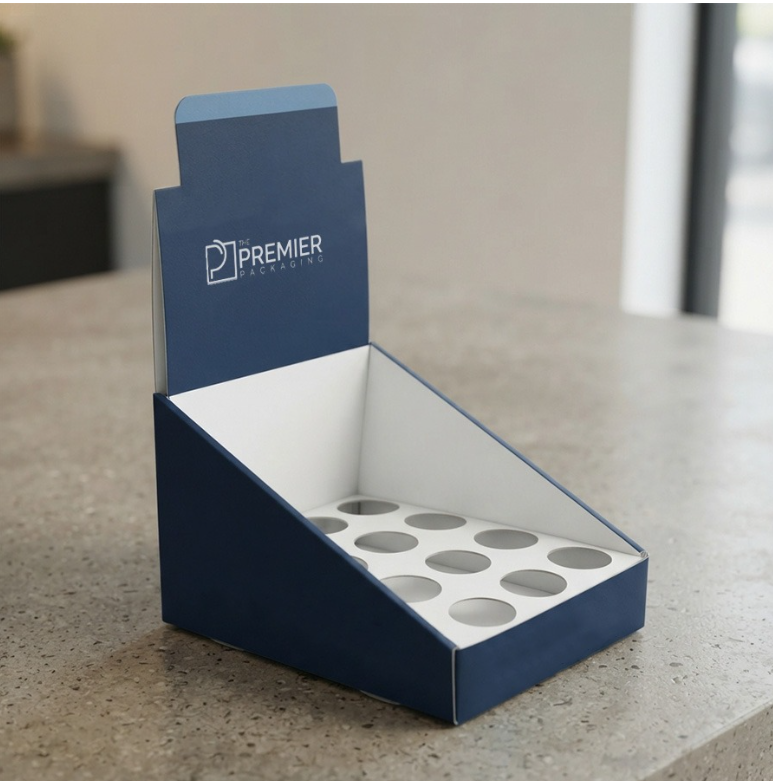
A display interrupts the pattern. The product is literally and visually drawn out from a shelf and placed at a new location. It could be a floor stand, an endcap unit, or even a small item, such as a toy display box, placed near a high-traffic point, but the impact will be the same – the product will no longer be background stock and will appear as a suggestion to stop and take a look.
That’s a mission-critical thing for toy brands, and it’s well taken. Children first hear the sound of color, then the sound of shape, and only then, the sound of a toy. Parents slow down near an organized group of products – even if they aren’t interested in purchasing a toy. A small toy display box placed at the aisle entrance can make a big difference and boost sales that might not have occurred if the product were simply placed in a quiet corner of the store.
Why Cardboard Displays Keep Winning
Big-box retailers are strict about what they’ll approve for the floor, and cardboard consistently clears that bar for a few practical reasons:
- It ships flat. Lower freight costs matter at Walmart’s scale, and flat-pack shipping reduces expenses considerably compared to rigid materials.
- It’s easy for store staff to handle. A display that’s simple to assemble and restock is far more likely to actually stay stocked. Complicated structures tend to get pushed aside during busy restocking hours.
- Print quality has improved a lot. Modern digital printing on corrugated board can produce sharp, branded graphics without inflating production costs the way custom plastic molds would.
- It’s disposable without waste guilt. Recyclability matters to both retailers and shoppers now, and cardboard checks that box without much effort.
A Quick Checklist Before You Blame the Product
Before assuming a slow-moving item is a dead product, it’s worth walking through a short list of questions:
- Does it have any placement outside its assigned shelf slot, an endcap, a checkout display, a seasonal feature?
- Is the display structure sturdy enough to survive repeated restocking without sagging or collapsing?
- Is the display sized appropriately for the product, or does it look empty and half-stocked most of the time?
- Does it actually contrast with the surrounding shelf, or does it fade into the same color scheme?
- Does it meet Walmart’s dimension, weight, and safety requirements for approved displays?
If the answer to most of these is “no” or “not sure,” visibility, not product quality is likely the real issue.
Quality Doesn’t Guarantee Attention
This is a direct one that should be repeated: A low-selling product is not necessarily a bad product. In a busy store such as the Wal-Mart store, a second-rate product that is well-positioned will sell more than a good product that is not. It’s not a glamorous reality of retail, but it is a reality.
This is because the brands that consider display strategy as a part of the product launch rather than an afterthought that gets added on nearer to the end of the manufacturing process, begin to notice the difference in sell-through information in the first couple of restocking cycles.
Brands that treat display strategy as part of the product launch, not an afterthought bolted on once manufacturing wraps up, tend to see the difference in sell-through data within the first few restocking cycles.
Final Words
If sales numbers aren’t matching expectations, it’s worth asking a different question than “what’s wrong with the product.” Ask instead whether shoppers are even seeing it. A dedicated, well-built display, whether that’s a full-floor unit or something more targeted, like a small toy display box near the right traffic path, can turn an easily missed item into one that actually gets picked up. Sometimes the fix has nothing to do with reformulating the product or cutting the price. It’s just making sure people notice it’s there.