

Today’s most exciting products aren’t simply designed to perform a function. They are built to understand, talk, reply, and make technology easier to use. From watches and health tools to connected machines and smart products, smart devices are changing what companies can create.
Behind every successful smart product is a combination of electronics, embedded systems, software, artificial intelligence, and thoughtful product engineering. When teams develop these elements separately, they can easily miss important details. A powerful processor may create battery challenges. A compact enclosure may limit sensor performance. A sophisticated software application may not work as expected with the underlying hardware.
This is why businesses increasingly work with a Custom AI Hardware Design Agency that can connect the complete development process.
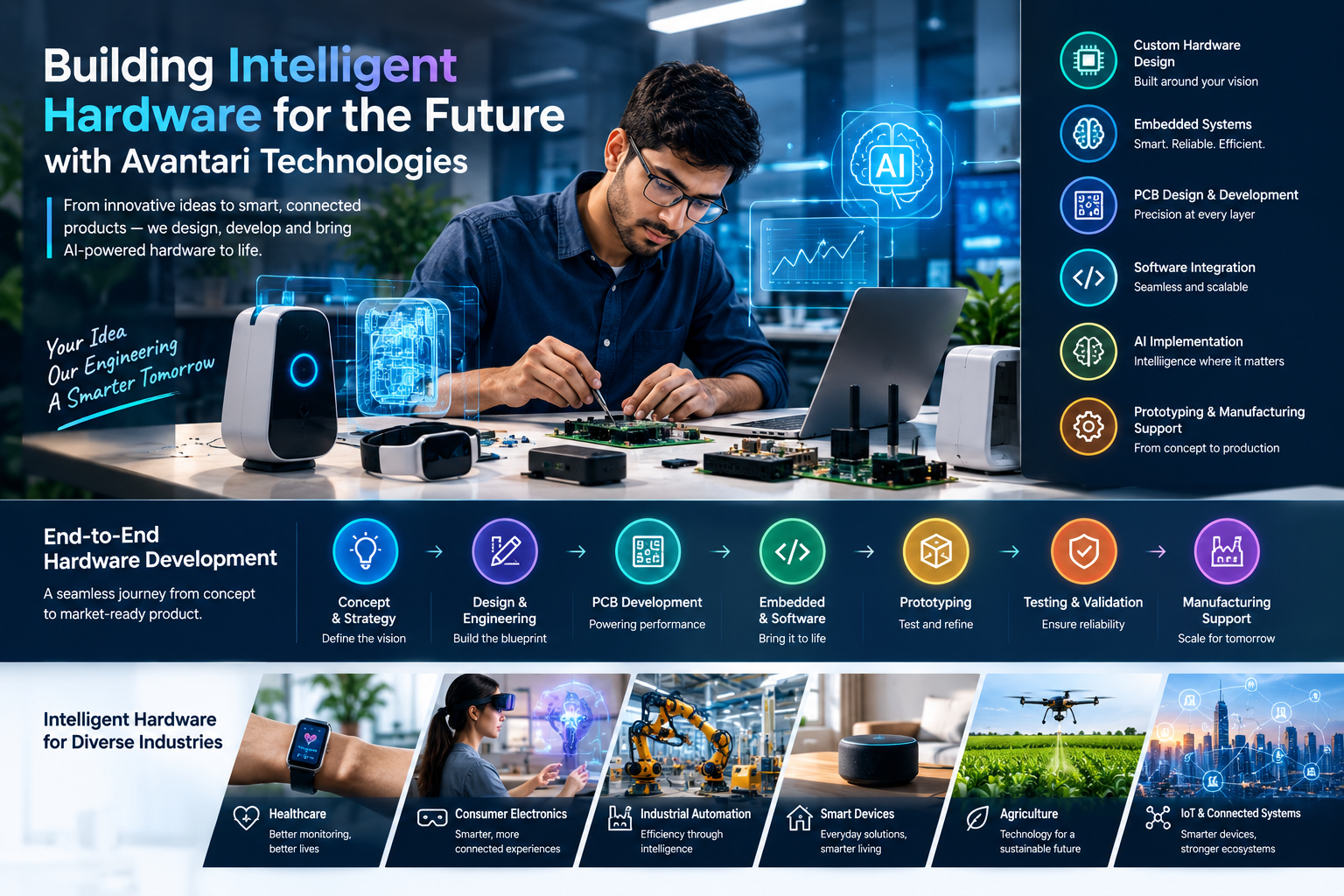
Avantari Technologies combines hardware engineering, embedded systems, PCB development, software integration, and intelligent technologies to turn product ideas into functional solutions. It adopts an approach to innovation: first understanding the product challenge, then designing and building the technology that solves the problem for customers worldwide and teams.
What Makes Intelligent Hardware Different?
Traditional electronic products were often built around a fixed purpose. A device performed a specific task, and its capabilities were determined largely by its physical components.
Modern intelligent products are more connected and adaptable. They collect information through sensors. They process data locally. Via cloud platforms. They communicate with devices. They respond to changing conditions. Artificial intelligence helps them recognize patterns. It helps them make decisions. It helps them offer experiences.
However, adding intelligence to hardware is not as simple as installing an AI model. The entire product architecture must support it. A smart device may need to balance:
- Processing power and battery life
- Sensor accuracy and physical placement
- Connectivity and data transfer
- Compact product dimensions
- Thermal performance
- Firmware reliability
- User experience and software integration
- Manufacturing feasibility and long-term scalability
A Custom AI Hardware Design Agency works with businesses to look at all their needs at once, rather than fixing each problem separately. When a company builds a product this all‑in‑one way cuts technical risk and builds a solid base for later growth and future success today now.
From an Idea to a Functional Product
Every hardware innovation begins with an idea. A new wearable, a medical device, an intelligent industrial solution, or a consumer product can be designed around a completely new way to interact. The challenge is to turn an idea into something that can be tested and improved.
Avantari Technologies approaches product development by linking the vision with practical engineering decisions. Before selecting components or building a circuit board, a product’s purpose, its users, its operating environment, and its technical requirements must be understood.
This stage is important because many product failures start with assumptions that were never tested. Questions such as these can shape the entire development process:
- What problem will the product solve?
- Which features are essential for the first version?
- What type of sensors or inputs will be required?
- How much processing should happen on the device?
- What power source will support the product?
- How will the hardware communicate with applications or cloud services?
- Can the design eventually be manufactured at scale?
By solving these questions, companies can stop spending a lot on a design that might need big changes later. A Custom AI Hardware Design Agency provides value by helping convert broad concepts into a clear technical direction. The result is not just a prototype, but a product architecture that can evolve.
Hardware Engineering Built Around the Product
A successful intelligent device depends on the quality of its electronics. Every component—from the processor and sensors to the power system and communication modules—must work together reliably.
PCB design plays a central role in this process. A printed circuit board does more than hold components. It controls signal flow, power distribution, and communication between parts. Good PCB design means attention to component placement, routing, power use, signal quality, heat, and how the board will be made later.
For AI devices, this is more critical. High-performance tasks need hardware. Every decision affects speed, reliability, and efficiency. A well-designed board makes the system work right and last longer. Wireless products may need careful antenna and communication planning. Portable devices must balance performance with limited battery capacity.
Avantari Technologies connects PCB and hardware development with the wider product architecture. This helps ensure that electronics are designed not in isolation, but around the product’s intended performance and user experience.
Startups can get access to types of engineering skills without needing a big internal team. Established companies can use this to help with projects that need extra technical skills.
Embedded Systems: The Intelligence Behind the Hardware
While hardware gives a product its shape, embedded software decides how that hardware works. Embedded systems control sensors, processors, displays, motors, and communication parts. They decide how a device turns on, reacts to input, and handles data. Connects with other systems. For a product, embedded development is the bridge between the real device and its smart features.
A wearable, for example, can gather movement or health data using sensors. The embedded system processes this data, manages battery use, and sends results to a mobile app. Embedded software development is important for making devices work properly and smartly. It helps turn parts into smart tools. Without it, devices would not function as intended.
An industrial device may monitor environmental conditions and trigger an action when unusual activity is detected. This requires firmware that is efficient, reliable, and designed specifically for the selected hardware.
A Custom AI Hardware Design Agency with embedded engineering capabilities can help ensure that hardware and firmware are developed together. This reduces compatibility issues and makes it easier to optimise the system as development progresses.
Avantari Technologies focuses on the link between electronics and embedded intelligence. By combining hardware and software skills in one development process, the company helps businesses create products that’re quick to respond, connected, and useful in everyday life.
Integrating AI Into Physical Products
Artificial intelligence is becoming an important part of modern product development, but its implementation depends heavily on the hardware environment.
Some products require real-time processing directly on the device. Other people use cloud-based systems for complex tasks. The best way to handle things depends on things like internet connection, privacy, how something needs to respond, how long the battery lasts, and how much processing is needed.
This is where the job of a Custom AI Hardware Design Agency is really important. Designing AI hardware means making choices about processors, memory, sensors, communication systems, and how to manage power. These choices affect not only how well an AI feature works but also how big, how expensive, how reliable, and how easy to use the final product is.
Avantari Technologies looks at product development by seeing AI as part of the whole system. Instead of adding artificial intelligence as an extra feature, at the end it can be built into the hardware and software from the start. This method helps create products that can see their environment, process data, and give answers. The result can be a more natural and useful technology experience—one where intelligence is built into the product itself.
Prototyping That Solves Real Engineering Problems
A prototype is one of the stages in hardware development. The prototype gives businesses an opportunity to test whether their assumptions work outside the planning stage. A functional prototype can reveal problems that’re difficult to identify through diagrams or simulations alone. A sensor may not perform as expected in its environment and increase costs for businesses significantly.
A battery may not provide sufficient operating time. A circuit board may need changes to support the required processing performance.
These discoveries are valuable because they happen before full-scale production. Avantari Technologies supports product development through engineering and prototyping. The goal is to move beyond concepts and create working systems that can be evaluated, refined, and improved. Real-world testing leads to designs and faster innovation.
A well-planned prototype can help teams understand:
- Whether the core technology works
- How users interact with the product
- Which components require improvement
- How hardware and software communicate
- What technical risks remain before production
- Which features should be prioritised for the next version
This iterative process helps businesses make informed decisions and develop products with greater confidence.
Supporting Innovation Across Industries
Intelligent hardware has uses in areas such as healthcare, consumer technology, industrial automation, education, entertainment, and connected environments, offering new possibilities.
Medical and wellness devices may use sensors and embedded intelligence to help with monitoring and personalized experiences, improving care. Wearables can combine electronics with mobile apps and data‑driven features, giving users real‑time insights. Industrial products use systems to improve daily monitoring, automation, and operational efficiency, reducing downtime.
Each industry has design needs. A wearable prioritises comfort and battery life. An industrial device needs durability and continuous operation. A consumer product focuses on simplicity and looks. A healthcare device needs reliability and careful data handling.
Avantari Technologies’ multidisciplinary approach allows businesses to explore these different possibilities while maintaining a connection between product vision and engineering execution.
As a Custom AI Hardware Design Agency, we work on various types of devices. Our goal is to help businesses create technology that fits their needs, their audience, and their long-term plans.
Why an Integrated Development Partner Matters
Hardware projects typically require teams, suppliers and technical experts. If these groups do not coordinate well, progress. Costs rise. This lack of coordination can lead to delays in scheduling increase, in rework and a risk of errors.
A change in the electronics design may affect firmware. A software requirement may require a different processor. A mechanical change may influence battery placement or sensor performance. An integrated development partner helps reduce these communication gaps.
Avantari Technologies brings together product engineering capabilities across hardware, embedded systems, software and artificial intelligence. This creates a connected development process in which decisions can be evaluated from multiple technical perspectives.
For businesses this means handoffs, between unrelated teams and a clearer understanding of how the product is progressing. It also creates flexibility. A startup can begin with a proof of concept and gradually develop the product as its requirements become clearer. An established company can use engineering expertise to explore new technologies without disrupting its existing operations and the team remains aligned and everyday frequently.
Designing for the Future, Not Just the First Prototype
A product must be designed with the future in mind. Even if the first version has features, the base structure should allow for growth. Future plans might involve software, better sensors, more connections, changes in production, or more uses. This is especially important for devices because technology changes fast.
A processor, AI model, or communication standard selected today may need to support future updates and integrations.
Avantari Technologies focuses on developing products with practical engineering foundations. By thinking about hardware, software, and how people use technology together, the company helps businesses make systems that can change as their needs change. The goal is not just to make a device that works once. It is to create a product foundation that can support continued innovation.
Conclusion
The future of product development belongs to intelligent systems that combine physical hardware with software and artificial intelligence. Building these products successfully requires more than technical components. It requires a clear product vision, strong engineering decisions, practical prototyping, and collaboration across multiple disciplines.
A Custom AI Hardware Design Agency can help businesses navigate this complexity by bringing together electronics, PCB development, embedded systems, AI integration, and product engineering.
Avantari Technologies supports this integrated approach to hardware innovation. From early product concepts and electronic architecture to functional prototypes and intelligent connected systems, its capabilities help businesses turn ambitious ideas into practical technology products.
For companies looking to develop the next generation of smart devices, wearables, connected products, or intelligent machines, the right engineering partner can provide the technical foundation needed to move from an idea to something real, reliable, and ready for the future.