
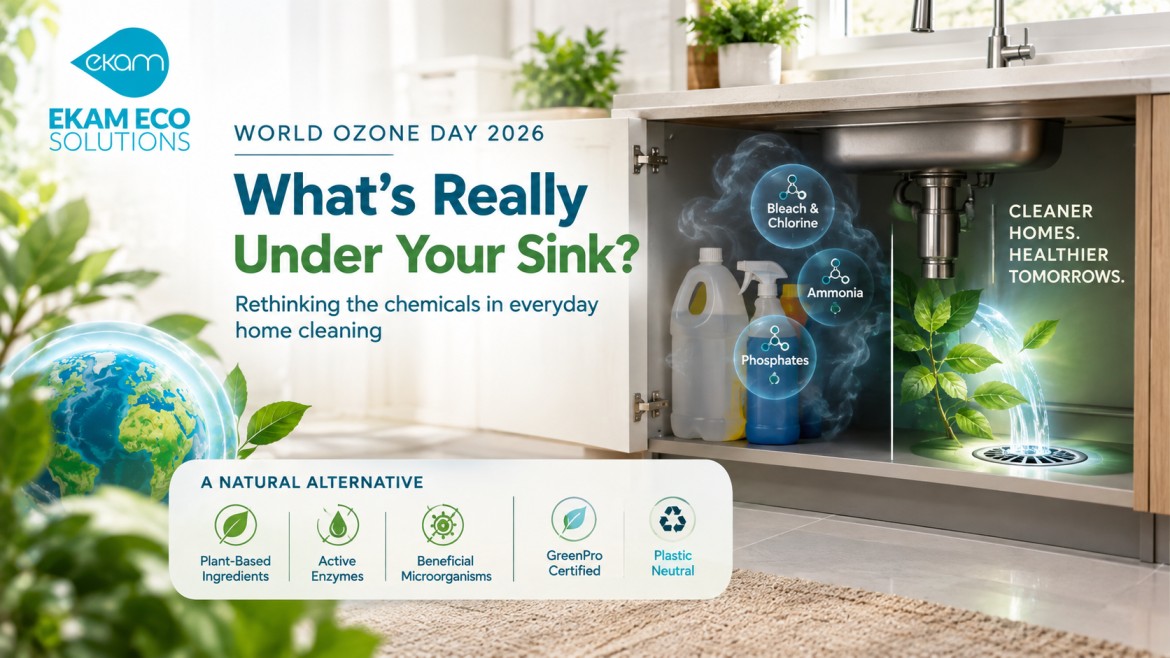

September 16, 2026 — The ozone layer may be far above us, but some of the environmental choices worth thinking about on World Ozone Day are much closer to home.
Look under an average kitchen sink and there may be a floor cleaner, toilet cleaner, dishwashing liquid, multipurpose spray, disinfectant and several other household products. Each has a job to do. But the ingredients inside those bottles—and what happens to them during and after use—rarely receive the same attention as the cleaning result itself.
On World Ozone Day 2026, Ekam Eco Solutions, the company behind Zerodor CARE, is using the occasion to encourage Indian households to take a closer look at the chemistry of everyday cleaning.
The message is not that households should stop using cleaning products. Nor is it that every conventional cleaner presents the same risk. Cleaning formulations differ widely, and products can be safe and effective when used correctly.
Cleaning our homes effectively becomes a challenge when people think about what they bring in the air they breathe during use and what finally falls into the drain. This worry grows stronger as people move beyond scent and quick fixes. They now look closely at ingredients, air quality and environmental impact. Cleaning our homes effectively truly matters. Caring for our homes today means keeping them safe and healthy every day.
World Ozone Day Is About More Than the Ozone Layer
September 16 is the International Day for the Preservation of the Ozone Layer, a day that remembers when the Montreal Protocol was signed in 1987. We can all contribute to protecting our planet today.
The ozone story is a strong example of how science can drive environmental action. It proves that when science, law factories and people all go in the direction with clear commitment environmental problems can be solved.
This history gives a lesson for today’s environmental challenges. Not every environmental problem is about ozone. We should not blame household cleaning products for harming the ozone layer. Only a specific set of chemicals that are covered by agreements actually harm the ozone layer.
But World Ozone Day provides a natural moment to ask a wider question about everyday consumption: How much attention do we give to the environmental consequences of the products we use repeatedly?
For household cleaning, that conversation includes indoor air quality, chemical handling, wastewater and the ingredients that enter the environment after use.
The “Clean” Smell Is Not the Same as Clean
For generations people have linked fragrances to cleanliness. A floor that smells sharply of cleaning products may seem spotless. The scent doesn’t prove the surface is actually clean. Some cleaning and household products release organic compounds or VOCs into the air. The U.S. Environmental Protection Agency lists these products as sources of VOC emissions. In fact indoor levels of some VOCs can be higher than levels.
The health effects depend on the chemical, how much is present and how long someone is exposed. This difference matters because homes are where families spend most of their time. Spending hours in a space with high VOC levels can affect health. People need to know that a pleasant smell does not mean a truly clean environment.
It also means that the familiar question—
“Does this cleaner work?”
—is only one question consumers can ask.
A more informed approach also considers:
“What is in it?”
“How should I use it?”
“Does it need ventilation?”
“What happens to it after it leaves my home?”
Three Ingredients Consumers Should Understand
There is no single formula used across the cleaning industry. A floor cleaner, toilet cleaner and dishwashing product can have completely different formulations. However, three ingredients commonly associated with household cleaning deserve particular attention because of how they behave and how they should be handled.
1. Bleach: Effective, But Highly Reactive
Bleach is often used for disinfecting, removing stains and whitening. When used the way it’s meant to be it works well. Bleach is very reactive. Never mix it with ammonia or acidic cleaners. That can make gases.
Labels on cleaning products are important for safety. Just because a cleaner seems stronger doesn’t mean it’s safer or better. Always read instructions. Use bleach carefully. Keep it away from chemicals. Safety comes first. Simple steps can prevent accidents. Be smart. Be safe.
2. Ammonia: Useful for Certain Cleaning Jobs
Ammonia is found in some household cleaners that are meant to remove grease and tough dirt. It can irritate eyes, nose, throat and lungs if concentrations are too high. A serious risk is mixing ammonia with bleach—it creates fumes. This is a safety warning.
For families the message is clear: use cleaning products only as directed. Always follow the instructions, ensure ventilation and handle them with care. Keeping these rules in mind helps protect everyone, in the home.
3. Phosphates: A Different Environmental Concern
Phosphates and other phosphorus compounds have historically been used in cleaning formulations because phosphates can improve cleaning performance. Environmental concern of phosphates is mainly linked to what happens after phosphates enter waterways.
Excess phosphates can cause pollution and under certain conditions can cause excessive algae growth that lowers oxygen levels in aquatic ecosystems. The true impact of phosphates depends on the cleaning formulation, the amount of phosphates released and wastewater‑treatment conditions.
That is why looking at cleaning products, from the surface view is incomplete. The life of a cleaning product does not necessarily end when the bucket is emptied.
What Does a More Responsible Cleaning Formula Look Like?
This is where Zerodor CARE takes a different approach. Developed by Ekam Eco Solutions, Zerodor CARE uses a biological cleaning approach built around plant-based surfactants, active enzymes and beneficial bacteria, with fruit extracts used in its formulations.
The idea is not complicated. By relying solely on ordinary chemicals people can use biological ingredients to tackle organic dirt, stains and smells. This method fits well with cleaning tasks. Consumers often use these products on floors, toilets, kitchens and other common surfaces again and again to keep homes fresh daily.
Zerodor CARE’s range includes solutions for floor cleaning, toilet cleaning and multipurpose cleaning, among other household applications. This does not mean that one product can replace every specialised disinfectant or cleaning method. Different surfaces and hygiene requirements need different solutions.
What Zerodor CARE offers is another choice for consumers who want to consider what their everyday cleaning products contain, rather than choosing solely on the basis of fragrance or the strongest chemical claim on the label.
“We Need to Look Beyond the Surface”
Uttam Banerjee, Founder & CEO, Ekam Eco Solutions, said:
“A clean home should not be defined only by what we can see or smell after cleaning. We should also be willing to ask what went into creating that result. Our homes, our indoor air and our water systems are connected to the choices we make every day. With Zerodor CARE, we wanted to develop a different kind of cleaning option—one that uses biological cleaning technology and carefully selected ingredients. World Ozone Day is a timely reminder that environmental responsibility begins with understanding the choices we make, even when those choices seem as ordinary as cleaning a floor.”
The distinction is important. Ekam Eco Solutions does not say that every cleaning product must be replaced for all users today. It believes the first step toward homes is simply becoming aware, in your daily life and choices.
A household might start with the product it uses most often. A facility manager might examine what is being used across hundreds of washrooms. A retailer might look more carefully at the environmental claims attached to the products it stocks. The principle is the same: Understand first. Choose better where practical.
From IIT Delhi Research to Everyday Cleaning
Ekam Eco Solutions began with research at IIT Delhi focusing on sanitation and water conservation. Over time the company expanded into management, cleaning, wastewater treatment and hygiene. Its journey reflects a commitment to eco- solutions, across multiple environmental challenges.
Zerodor CARE brings this broader sustainability approach into the consumer space. That transition is significant because environmental innovation is often discussed in terms of large infrastructure, industrial systems and government policy. Households make environmental decisions every day often without thinking.
The cleaner chosen for a floor is a choice. The product used in a toilet counts as an act. The liquid poured into a sink becomes a footprint. The packaging thrown away after the bottle is finished is environmentally friendly. None of these choices solve environmental problems on their own. But repeated across millions of households, everyday consumption decisions become part of a much larger picture.
GreenPro and Plastic Neutrality
The company’s CARE range has GreenPro certification. It offers a way to check environmental performance. Ekam Eco Solutions shows it is Plastic Neutral. This is part of its environmental plan. These certifications don’t mean a product has no impact. They show efforts to be sustainable. They help customers make choices. They support eco- practices. They encourage production. They show a commitment to the planet.
Rather, they provide consumers with additional information when comparing products and considering sustainability alongside performance, usability and price. That is increasingly important as environmental claims become more common in the consumer marketplace.
Shoppers should seek verifiable facts instead of vague words like green, eco or natural, on a label. Green eco claims need proof not just marketing buzz. Everywhere today.
Five Questions to Ask Before Buying a Household Cleaner
Consumers do not need chemistry knowledge to make better choices. Before buying or using a household cleaner a consumer can begin with five questions.
What are the active ingredients?
Read the label of judging a product only by its color, fragrance or marketing language.
Is the product heavily fragranced?
A strong smell may give the idea of freshness. Fragrance is not the same as cleaning power.
What precautions does the manufacturer recommend?
Pay attention to mixing, airing, surface suitability and warnings.
What happens after use?
Consider where the product goes once it enters drain water and how drain water is treated in your area.
Is there a suitable alternative?
If a product is used frequently, investigate whether another formulation can meet the everyday cleaning requirement and keep your home safe today.
These small questions move the talk, from “Does it clean?” to “How does it clean and what’s the cost of that choice?” People learn to read labels and feel confident choosing smarter cleaners today.
Cleaning Without Creating Fear
There is also an important middle ground in this conversation. Consumers should not be frightened into abandoning cleaning products. Nor should every conventional formulation be labelled dangerous without evidence.
Good environmental communication requires nuance. Bleach can have legitimate uses. Ammonia can be effective for particular cleaning tasks. Disinfectants are important in situations where infection control is required.
The objective is not to declare one category universally good and another universally bad. It is to give consumers more information so that they can choose products according to the job, the ingredients, the safety requirements and their own environmental priorities. That is the space Zerodor CARE is trying to occupy.
A Cleaner Home Can Also Mean a More Informed Choice
The most meaningful change may not come from replacing everything under the sink at once. It may begin with one bottle. One floor cleaner. One toilet cleaner. One product that a family uses several times a week.
For consumers who want to explore an alternative approach to everyday household cleaning, Zerodor CARE offers a range of products built around plant-based ingredients, enzymes and beneficial bacteria.
The range of natural cleaning products in India is available through the official Zerodor CARE store: https://www.shop.ekameco.com/
The bigger message, however, extends beyond one brand. World Ozone Day reminds us that environmental progress begins with understanding a problem and changing what we can.
Look under the sink. Read the label. Ask what is in the cleaner — and where it goes after the cleaning is done.
About Ekam Eco Solutions
Ekam Eco Solutions is an Indian company focused on sustainability working in sanitation, water management, cleaning, hygiene, wastewater and environmental solutions. Started from research at IIT Delhi it has developed products and technologies to tackle real-world environmental and hygiene issues. Its portfolio includes Zerodor waterless urinals, Zerodor CARE cleaning and hygiene solutions, drain-line maintenance technologies, odor management systems and wastewater treatment solutions.